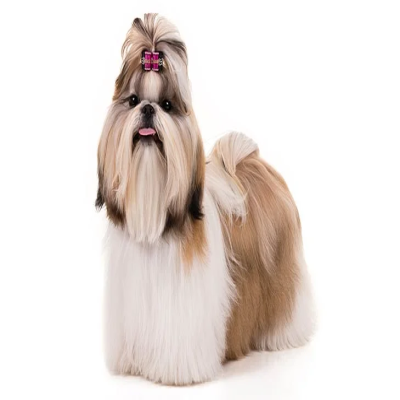
Shihtzu
Looking for a Shihtzu pup , Please do fill the the CONTACT US form
Happybark team will call you to guide through the process of connecting with an ethical breeder for the furry companion
Happybark helps you as follows:
1. Video of pups to choose the best pup
2. Connect with ethical breeder
3. Health report to be submitted to the pet parent
4. No to puppy mill
5. Vaccinated with certificate
SHIHTZU
THE BEST CUTE PUPPY TO CHECK AND HAVE
HEIGHT
9-10.5 inches
WEIGHT
9-16 pounds
LIFE EXPECTANCY
10-18 years
Breed Standard: A description of the ideal dog of each recognized breed, to serve as an ideal against which dogs are judged at shows, originally laid down by a parent breed club and accepted officially by national or international bodies.
General Appearance: The Shih Tzu is a sturdy, lively, alert toy dog with long flowing double coat. Befitting his noble Chinese ancestry as a highly valued, prized companion and palace pet, the Shih Tzu is proud of bearing, has a distinctively arrogant carriage with head well up and tail curved over the back. Although there has always been considerable size variation, the Shih Tzu must be compact, solid, carrying good weight and substance. Even though a toy dog, the Shih Tzu must be subject to the same requirements of soundness and structure prescribed for all breeds, and any deviation from the ideal described in the standard should be penalized to the extent of the deviation. Structural faults common to all breeds are as undesirable in the Shih Tzu as in any other breed, regardless of whether or not such faults are specifically mentioned in the standard.
Size, Proportion, Substance: Size - Ideally, height at withers is 9 to 10½ inches; but, not less than 8 inches nor more than 11 inches. Ideally, weight of mature dogs, 9 to 16 pounds. Proportion - Length between withers and root of tail is slightly longer than height at withers. The Shih Tzu must never be so high stationed as to appear leggy, nor so low stationed as to appear dumpy or squatty. Substance - Regardless of size, the Shih Tzu is always compact, solid and carries good weight and substance. Head: Head - Round, broad, wide between eyes, its size in balance with the overall size of dog being neither too large nor too small. Fault: Narrow head, close-set eyes. Expression - Warm, sweet, wide-eyed, friendly and trusting. An overall well-balanced and pleasant expression supersedes the importance of individual parts. Care should be taken to look and examine well beyond the hair to determine if what is seen is the actual head and expression rather than an image created by grooming technique.
Eyes - Large, round, not prominent, placed well apart, looking straight ahead. Very dark. Lighter on liver pigmented dogs and blue pigmented dogs. Fault: Small, close-set or light eyes; excessive eye white. Ears - Large, set slightly below crown of skull; heavily coated. Skull - Domed. Stop - There is a definite stop. Muzzle - Square, short, unwrinkled, with good cushioning, set no lower than bottom eye rim; never downturned. Ideally, no longer than 1 inch from tip of nose to stop, although length may vary slightly in relation to overall size of dog. Front of muzzle should be flat; lower lip and chin not protruding and definitely never receding. Fault: Snipiness, lack of definite stop. Nose - Nostrils are broad, wide, and open. Pigmentation - Nose, lips, eye rims are black on all colors, except liver on liver pigmented dogs and blue on blue pigmented dogs. Fault: Pink on nose, lips, or eye rims. Bite - Undershot. Jaw is broad and wide. A missing tooth or slightly misaligned teeth should not be too severely penalized. Teeth and tongue should not show when mouth is closed. Fault: Overshot bite. Neck, Topline, Body: Of utmost importance is an overall well-balanced dog with no exaggerated features. Neck - Well set-on flowing smoothly into shoulders; of sufficient length to permit natural high head carriage and in balance with height and length of dog. Topline - Level. Body - Short-coupled and sturdy with no waist or tuck-up. The Shih Tzu is slightly longer than tall. Fault - Legginess. Chest - Broad and deep with good spring-of-rib, however, not barrelchested. Depth of ribcage should extend to just below elbow. Distance from elbow to withers is a little greater than from elbow to ground. Croup - Flat. Tail - Set on high, heavily plumed, carried in curve well over back. Too loose, too tight, too flat, or too low set a tail is undesirable and should be penalized to extent of deviation.
Health
Because of their heavy coats and short faces, Shih Tzu do not tolerate heat well and are not good swimmers. Most Shih Tzu are generally healthy, and responsible breeders screen their stock for health conditions such as such as hip dysplasia, patellar luxation (a slipped kneecap), eye anomalies including cataracts, progressive retinal atrophy, retinal detachment, and corneal dryness and inflammation from excessive exposure to the air because of improperly closing eyelids.
Grooming
A Shih Tzu with a long coat requires daily brushing. Use a good-quality wire brush with flexible pins, and layer the hair to be sure you reach to the skin. A bath about every three or four weeks will help to keep the coat clean and at its best. Remember to comb the mustache and topknot daily, and gently clean the corner of the eyes with a damp cloth. To protect the Shih Tzu's eyes from being irritated, the hair on the top of the head should be trimmed short or tied up into a topknot. If you don't want to have to spend time on your dog's coat, the Shih Tzu can look adorable when clipped into a "puppy trim" by a professional groomer. Trimming nails and cleaning ears should be part of the Shih Tzu's grooming routine
Exercise
The Shih Tzu was bred to be a house companion. As such, they require minimal exercise. Short daily walks with their owner and indoor playtime will satisfy the activity needs of this small, short-legged companion.
Training
Training a Shih Tzu can be both an amusing and a frustrating experience. The breed tends to charm his owner into letting him have his own way, which can result in a chubby, less-than-completely-housebroken pet who is difficult to groom. Because Shih Tzu are such people dogs, training methods based on praise and rewards work best. Harsh corrections should not be used with this breed. Introduce desired new behaviors a bit at a time, be firm, and never give in while the dog is misbehaving. If he nips or jumps up on you, ignore him until he settles down, then praise him. Early socialization and puppy training classes are recommended and help to ensure that the Shih Tzu grows into a well-adjusted, well-mannered companion. When enrolling in a puppy class, be sure that the training methods used in the class are based on positive reinforcement
Nutrition
The Shih Tzu should do well on a high-quality dog food, whether commercially manufactured or home-prepared with your veterinarian's supervision and approval. Any diet should be appropriate to the dog's age (puppy, adult, or senior). Some dogs are prone to getting overweight, so watch your dog's calorie consumption and weight level. Treats can be an important aid in training, but giving too many can cause obesity. Learn about which human foods are safe for dogs, and which are not. Check with your vet if you have any concerns about your dog's weight or diet. Clean, fresh water should be available at all times.
Leave Your Comment
call us
+91 7660020250
Copyrights © 2024 happybark all right reserved.
Popular Search
- Farmina vet life obesity
- Royal canin satiety weight management
- Drools vet pro obesity
- Farmina vet life gastro